

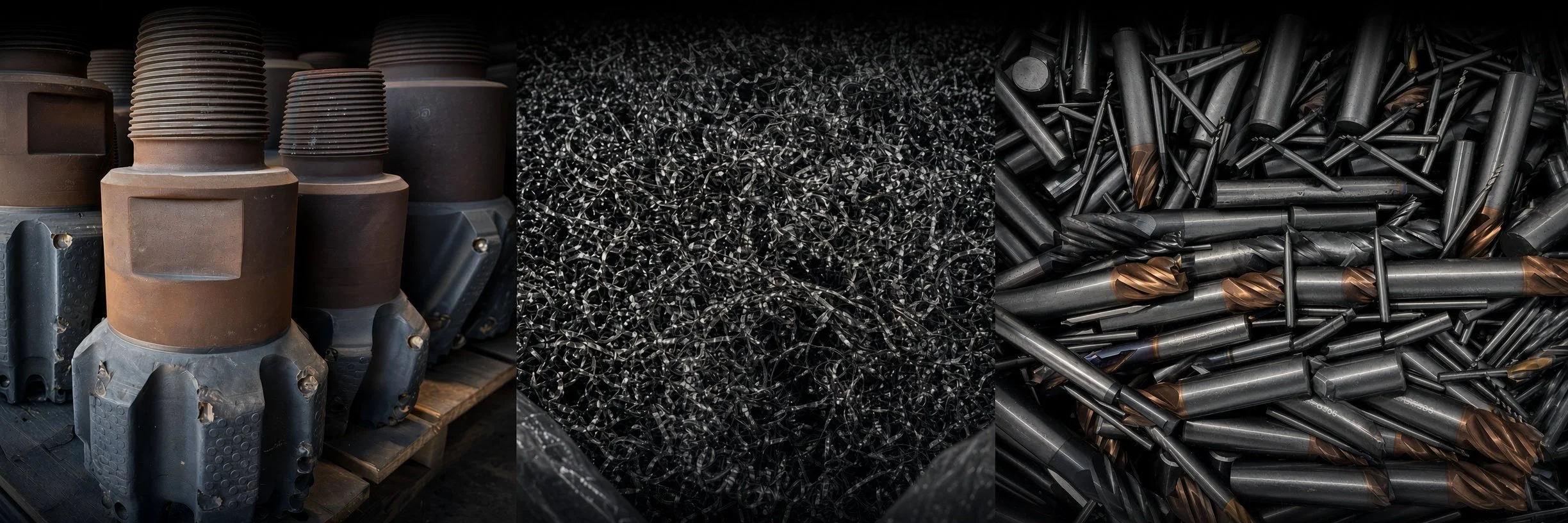
AMERMIN Technologies recovers tungsten, cobalt, nickel, copper, graphite, and silver from industrial scrap, refines them to specification, and returns them to the manufacturers that used them.
No mine
No foreign intermediary
A supply chain with five links is a supply chain with five failure points
Conventional route
- Foreign mine
- Refiner
- Component maker
- OEM
- Scrap
- Exported
Our route
- OEM
- AMERMIN
- OEM
We buy the worn out tooling, cutters, turnings, process them back to manufacturing spec, and sell the metal back as new material. Refining through distribution happens on U.S. soil.
A handful of countries control the mining and refining of nearly every critical mineral. Everything downstream of that inherits the risk. We took the links out.
Two operating companies, one material flow
Refining technology and materials

Processes and refines six critical minerals recovered from industrial scrap, then sells finished powders back into manufacturing. Operates the group’s MELT, blending, and carbide facilities across central Texas.
amermin.com- Soft-scrap & turnings processing
- Powder blending & MELT operations
- Tungsten powders production
- Material sales to OEMS & tooling makers
Recovery and distribution

Turnkey asset recovery for the drill bit industry, serving manufacturers, distributors and suppliers across oil and gas, mining, geothermal, water well and construction. Supplies, repairs and recycles PDC bits and cutters, and sources the components that downhole tool production depends on.
drillbitexchange.com- PDC drill bits & cutters
- PDC repair & refurbishment services
- Used & surplus asset recovery
- Tungsten carbide hardfacing products
AMERMIN Technologies holds the businesses that collect the scrap and the businesses that refine it, so the metal never has to leave the group.
Six critical minerals, recovered from what industry throws away
Each has its own feedstock stream, its own processing route, and its own end markets. All six come out of scrap that American plants already generate.
Tungsten
Carbide inserts, drill bits, cutting tools, machining turnings
Tooling, defense components, coatings, aerospace & industrial parts
Cobalt
Cemented carbide binder, superalloy scrap, spent catalyst
Superalloys, coatings, magnets, batteries, carbide production
Nickel
Superalloys, drill bits, spray coatings, stainless & plating scrap
Superalloys, stainless steel, batteries, plating, spray coatings
Copper
Wire, drill bits, motor windings, electrical assemblies, EV batteries, welding consumables
Electrical distribution, motors, data center infrastructure, EV batteries, rocket nozzles
Graphite
Spent electrodes, crucibles, refractory scrap, molds, EV batteries
Electrodes, anode material, refractories, coking, bar stock, lubricants
Silver
Electrical contacts, brazing alloys, electronic assemblies, blast media
Contacts & switchgear, brazing alloys, photovoltaic cells, electronics
Scrap is the domestic ore body. Roughly half of U.S. tungsten imports already arrive as scrap, and the same pattern holds across the rest.
Whoever aggregates it controls the feedstock.
Seven sites, built around the flow of material
Scrap arrives, moves through receiving, sorting, melt & carbide production, and leaves as finished material. Each site does one part of that sequence.
Del Valle, TX
R&D, powder blending and soft scrap processing
Liberty Hill, TX
Material receiving & shipping, turnings processing, R&D
Briggs, TX
Tungsten carbide facility & Department of Energy award expansion site
Lampasas, TX
MELT operations
Fort Worth, TX
Consolidation & staging
Monterrey, MX
Scrap consolidation & staging, gateway to Latin America
Buenos Aires, AR
Scrap consolidation & staging, gateway to South America
Where the metals go
These minerals sit inside most industrial supply chains that matter, usually in the part that wears out first. That is what makes them recoverable.
Energy
Drill bits, catalysts, nuclear shielding
W · Co · Cu
Defense
Kinetic penetrators, armor, hypersonics
W · Co · Ni
Aerospace
Counterweights, turbine blades, shielding
W · Ni · Co
Semiconductors
Sputtering targets, micro drills, CVD films
W · Cu · Ag
Automotive
Electrodes, EV batteries, sensors, wiring
W · Cu · Ag · Cu
Mining
Picks, hardfacing, braze, drill bits, scrapers
W · Co · Cu · Ag
Medical
Imaging, radiation shielding, contacts
W · Ag · Cu
Manufacturing
Cutting tools, dies, electrodes, superalloys
W · Co · Cu · Ni · C
We started by picking up what everyone else was throwing out
The United States mines almost none of the minerals its industry runs on. It discards a great deal of them.
Worn cutting tools, spent drill bits, carbide inserts, machining turnings, spent electrodes, stripped wire, used contacts. Every plant in the country generates them, and for decades most of that metal left the country to be reprocessed somewhere else and sold back at a markup. The material was never the problem. The route was.
Ryan McAdams founded AMERMIN in Austin in 2017, recycling oil and gas tooling, and grew it into a multi-commodity processing and refining business without significant outside equity. Drill Bit Exchange had been working the same problem from the other end, recovering and refurbishing downhole tooling for manufacturers across oil and gas, mining and construction. One company collected the material. The other knew how to turn it back into manufacturing grade materials.
Running them side by side worked, but it meant the scrap had to change hands to move one step down the chain. Bringing both under a single parent removes that handoff. Material now flows from a customer's plant floor to finished powder without leaving the group, and the capital behind the processing sites answers to one balance sheet.
2017
AMERMIN is founded in Austin as an oil and gas tool recycling company, starting out of Ryan's garage.
2018 to 2025
The business widens from oil and gas tooling into multi-commodity processing, and the footprint builds out across central Texas: receiving and turnings at Liberty Hill, MELT operations at Lampasas, powder blending and R&D at Del Valle, carbide production at Briggs. Staging opens in Fort Worth, then Monterrey and Buenos Aires to reach Latin & South American feedstock.
January 2026
The Department of Energy awards $11.5 million through its Office of Fossil Energy and Carbon Management to expand tungsten carbide production at Briggs, targeting a threefold increase in output.
August 2026
AMERMIN Technologies is formed in Texas as the parent of AMERMIN and Drill Bit Exchange, putting recovery and refining under one company.
2027
Automation across the processing lines, increased feedstock sourcing, and deeper refining capacity across all six minerals.
2028
Full-scale production of tungsten carbide is realized in Briggs, TX. Production increases 600% over 2025-2026, supplying up to 18% of US domestic tungsten carbide consumption.
2029
Feedstock agnostic processing technologies are scaled, built on AMERMIN Technologies patented IP & integrated automation.
2030 - 2032
AMERMIN Technologies emerges as the preeminent domestic midstream supplier of critical minerals.
Recognition
This significant federal investment in Texas-born AMERMIN is a testament to the important work the company is doing to increase American manufacturing independence and reduce reliance on foreign sources.
Representative John Carter, Texas 31st District
Federal funding, congressional attention & customers who put our product somewhere it cannot be serviced.
Material on the Moon
AMERMIN supplies material to Firefly Aerospace, whose Blue Ghost lander reached the lunar surface in 2025.
ISO:9001 certified
The Del Valle processing facility operates under a certified quality management system.
Talk to us about material

Austin, Texas
9442 Capital of Texas Hwy N
Arboretum Plaza One, Suite 500
Austin, Texas 78759
Whether you are buying finished powders or clearing worn tooling out of a plant, start with either company below.